
August 15, 2026
Should You Really Add Ganga Aarti to Your Wedding? Here’s the Honest Answer
Every week, we get some version of the same hesitant question from a couple or their parents: “Is it actually a good idea to bring Ganga Aarti into our wedding, or are we overcomplicating things?” It’s a fair question. A wedding already has a dozen rituals, a tight schedule, and a guest list with different comfort levels around religious ceremonies. Adding something as visually and spiritually significant as the Ganga Aarti feels like a big decision.
So instead of just saying “yes, do it,” here’s an honest look at how a Ganga Aarti ceremony actually affects a wedding — and the fears we hear most often, addressed one by one.

How Ganga Aarti Actually Affects a Wedding
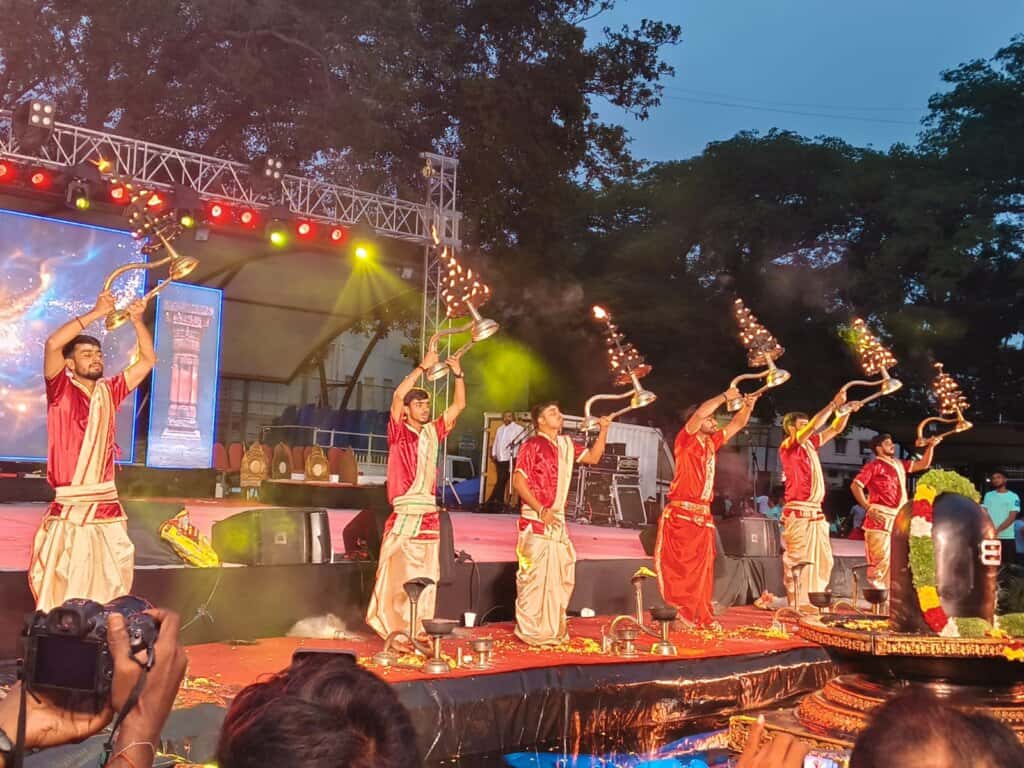
It becomes the emotional peak of the event, not a side ritual. Most wedding rituals happen among family, quietly, early in the ceremony. Ganga Aarti is the opposite — it’s a full-sensory, all-guest moment with lamps, chants, conch sounds, and coordinated priests. Families consistently tell us it’s the part guests talk about afterward, more than the reception decor or the food.
It changes the pacing of your event, in a good way. A Ganga Aarti ceremony runs 30–40 minutes and works best as a distinct block in your schedule — usually right before or during the main wedding rituals, or as a standalone evening ceremony. It gives your event a clear “moment” rather than everything blending into one long function.
It shifts photography and videography completely. Couples who’ve had a Ganga Aarti at their wedding almost always say their photographer got the best shots of the whole event during the Maha Aarti step — the synchronized lamps against the evening light are difficult to recreate with any other ritual.
It does add a layer of planning. This is the honest part: priests, lamps, stage setup, and sequencing take coordination. That’s a real cost, not a myth — which is exactly why couples hire an organizer rather than attempting it independently.
Common Fears & Misconceptions, Answered
“Isn’t Ganga Aarti only meant to be performed on the actual river Ganga? Won’t it feel fake anywhere else?”
This is the single most common concern, and it’s worth taking seriously. The Ganga Aarti performed at the ghats is dedicated specifically to the river herself, in that exact location — that part can’t be replicated elsewhere, and no honest organizer should claim otherwise. What is replicated at a wedding is the ritual structure and the priests who perform it: the same Kashi-trained priests, the same sequence of steps, the same chants. Couples aren’t trying to recreate “the river’s aarti” in another city — they’re bringing the ceremonial tradition and its priests to their own celebration. Framed that way, most families find it feels intentional rather than imitation.
“Will it seem overly religious for guests who aren’t very ritual-focused?”
Ganga Aarti is visually striking before it’s religiously heavy — the lamps, the synchronized movement, and the sound are what draw people in, even guests who don’t know the mantras being chanted. In our experience, it plays more like a cultural spectacle to a mixed guest list than a strict religious rite. Most couples position it as a ceremonial highlight of the evening rather than a devotional service guests are expected to participate in.
“Is it disrespectful to adapt a sacred temple/ghat ritual for a wedding?”
This concern usually comes from not knowing how the adaptation actually works. Six of the seven steps in the wedding version are performed exactly as they are on the ghats — nothing shortened, nothing altered. The only addition is the Jaimal step, where the couple’s own garland exchange is woven into the ceremony. The ritual isn’t being diluted; a wedding moment is being added into it, with the same priests who perform it traditionally. Respect for the tradition depends heavily on who’s performing it — which is why verifying that your priests are genuinely Kashi-trained (not local performers briefed for the day) matters more than the concept itself.
“What if it doesn’t suit our wedding venue?”
This is a logistics fear more than a ritual one, and it’s usually solvable. The ceremony has been performed at mandaps, banquet halls, lawns, resorts, and destination wedding venues across 28 states — it doesn’t require a riverside setting. What it does need is enough open space for the priest formation and lamp movements, and a setup window of 2–3 hours beforehand. A good organizer will assess your venue in advance rather than promising it’ll “just work” on the day.
“Isn’t this only for very traditional or religious families?”
Increasingly, no. Many couples who choose Ganga Aarti aren’t doing it purely for religious reasons — they’re doing it because it photographs beautifully, it’s culturally rooted rather than generic, and it gives the event a moment that feels distinct from a typical wedding template. It’s become as much an aesthetic and experiential choice as a spiritual one.
“Will it blow our budget?”
Cost is a legitimate concern, and it scales with the number of priests, stage size, and add-ons like a Masal entry — not with the ritual itself. Packages exist across a range specifically so families can choose the scale that fits their budget rather than feeling priced out of the experience entirely.
So — Is It a Good Idea?
For most weddings, yes — but with one condition: it’s only as good as the priests performing it. A genuine Kashi-trained team performing the complete seven-step ritual creates a moment guests remember for years. A shortened, generic version performed by local substitutes can feel exactly like the “fake” experience families worry about in the first place. The ritual itself isn’t the risk — the vendor is.

Thinking about adding Ganga Aarti to your wedding but still have questions? We’re happy to walk you through how it would actually work for your venue, guest list, and budget — no pressure, just a straight answer.
📞 Call — +91 78088 99232 💬 WhatsApp Us Now
Frequently Asked Questions
Does Ganga Aarti at a wedding replace any traditional wedding rituals? No. It’s typically added as its own ceremonial block — often before or alongside the main rituals — rather than replacing anything in your existing wedding sequence.
Can Ganga Aarti be performed at destination weddings outside India’s river cities? Yes. The ceremony is performed at venues across 28 states, including destination wedding locations, resorts, and banquet halls with no river nearby.
Do guests need to participate in the ritual, or can they just watch? Guests are welcome to simply watch. Unlike a religious service, there’s no expectation of guest participation — it’s designed as a ceremonial experience for everyone present.
How do I know if the priests performing at my wedding are genuinely Kashi-trained? Ask directly about their training background and whether they perform the full seven-step sequence. A vendor unwilling to answer clearly, or one that only performs a shortened lamp ceremony, is a sign to look elsewhere.
How to Book Ganga Aarti for Your Wedding: Step-by-Step Guide (2026)